

What is a Go-to-Market (GTM) Strategy? Complete Guide for 2026
A go-to-market (GTM) strategy is the operating plan that turns a product into revenue. It answers who you sell to, why they should care, how you reach them, what you charge, and how you measure progress from first touch to closed-won and expansion. In 2026, GTM is no longer a launch checklist you write once — it is a living system that connects positioning, channels, sales motion, and customer success.
This guide explains what a GTM strategy is, why it matters now, the core building blocks, a practical framework you can run, common mistakes to avoid, and how to adapt GTM for AI-assisted teams and multi-channel buyers.
What Is a Go-to-Market Strategy?
A go-to-market strategy is a coordinated plan for bringing a product or service to a defined market. It aligns marketing, sales, product, and customer teams around one commercial narrative: the problem you solve, the buyers who feel that problem most, the proof that you solve it better than alternatives, and the path from awareness to purchase.
GTM vs marketing plan vs business plan
These terms get mixed up. A business plan covers the full company model, financing, and long-term vision. A marketing plan focuses on demand generation and brand activities. A GTM strategy is narrower and more commercial: it is the bridge between product readiness and revenue outcomes for a specific offer, segment, and time window — for example, launching a new SaaS module in North America in Q3.
When you need a GTM strategy
You need a dedicated GTM plan when you launch a new product, enter a new segment or geography, change pricing motion (self-serve to sales-assisted), or restart growth after flat pipeline. If “we post content and hope demos appear” is the current system, you do not have a GTM strategy — you have activity.
Why GTM Strategy Matters in 2026
Buyer journeys are fragmented across search, social, communities, AI assistants, webinars, and peer recommendations. Acquisition costs remain high in competitive categories, and sales cycles punish unclear messaging. Teams that treat GTM as improvisation burn budget on channels that never convert and hand sales leads that were never qualified.
The cost of a weak GTM
Weak GTM shows up as high traffic with low intent, demos that stall after pricing talks, long onboarding with early churn, and marketing-sales blame cycles. Strong GTM reduces waste by forcing focus: one primary ICP, one core offer story, a channel mix you can staff, and metrics that reveal bottlenecks early.
What changed recently
In 2026, GTM teams also design for AI-mediated discovery. Buyers ask tools for shortlists, compare vendors in public forums, and expect product-led proof before talking to sales. Your GTM must include how you show up in those environments — clear category language, credible proof assets, and a path from self-serve evaluation to human conversation when deal complexity rises.
Core Building Blocks of a Modern GTM Strategy
1. Ideal Customer Profile (ICP) and buyer personas
Start with who is most likely to buy, succeed, and expand. An ICP defines firmographics and context: industry, size, tech stack, buying trigger, and urgency. Personas define the people inside that account — economic buyer, champion, user, and blocker. Without ICP clarity, every other GTM decision becomes guesswork.
2. Positioning and messaging
Positioning is the market slot you occupy. Messaging is how you say it to each persona. Great 2026 messaging is specific: problem, consequence, unique mechanism, proof, and outcome. Avoid feature dumps. Lead with the job the buyer is hiring you to do and the risk of doing nothing.
3. Offer, packaging, and pricing
Your offer is not only the product. It includes packaging tiers, onboarding, guarantees, implementation options, and commercial terms. Pricing must match the motion: product-led freemium, usage-based, seat-based, or sales-led enterprise deals. Misaligned pricing kills otherwise strong GTM plans.
4. Channel strategy
Channels are where attention becomes pipeline. Typical mixes include inbound content and SEO, paid acquisition, outbound sales, partnerships, community, events, and product-led loops. The key is concentration: pick a primary motion and one or two support motions you can execute with quality. Spreading thin across eight channels is not a strategy.
5. Sales motion and handoffs
Define how leads move from marketing to sales to onboarding. Include qualification criteria, SLA response times, demo scripts tied to personas, and rules for expansion. GTM fails when marketing optimizes for volume while sales optimizes for late-stage deal quality with no shared definition of a qualified opportunity.
6. Metrics and feedback loops
Instrument the funnel: traffic quality, activation, MQLs/SQLs, win rate, sales cycle length, CAC, payback, activation-to-value time, and early retention. Review weekly. Feed learnings into messaging, offer packaging, and channel spend. GTM without a feedback loop becomes a museum of outdated assumptions.
A Practical GTM Framework for 2026
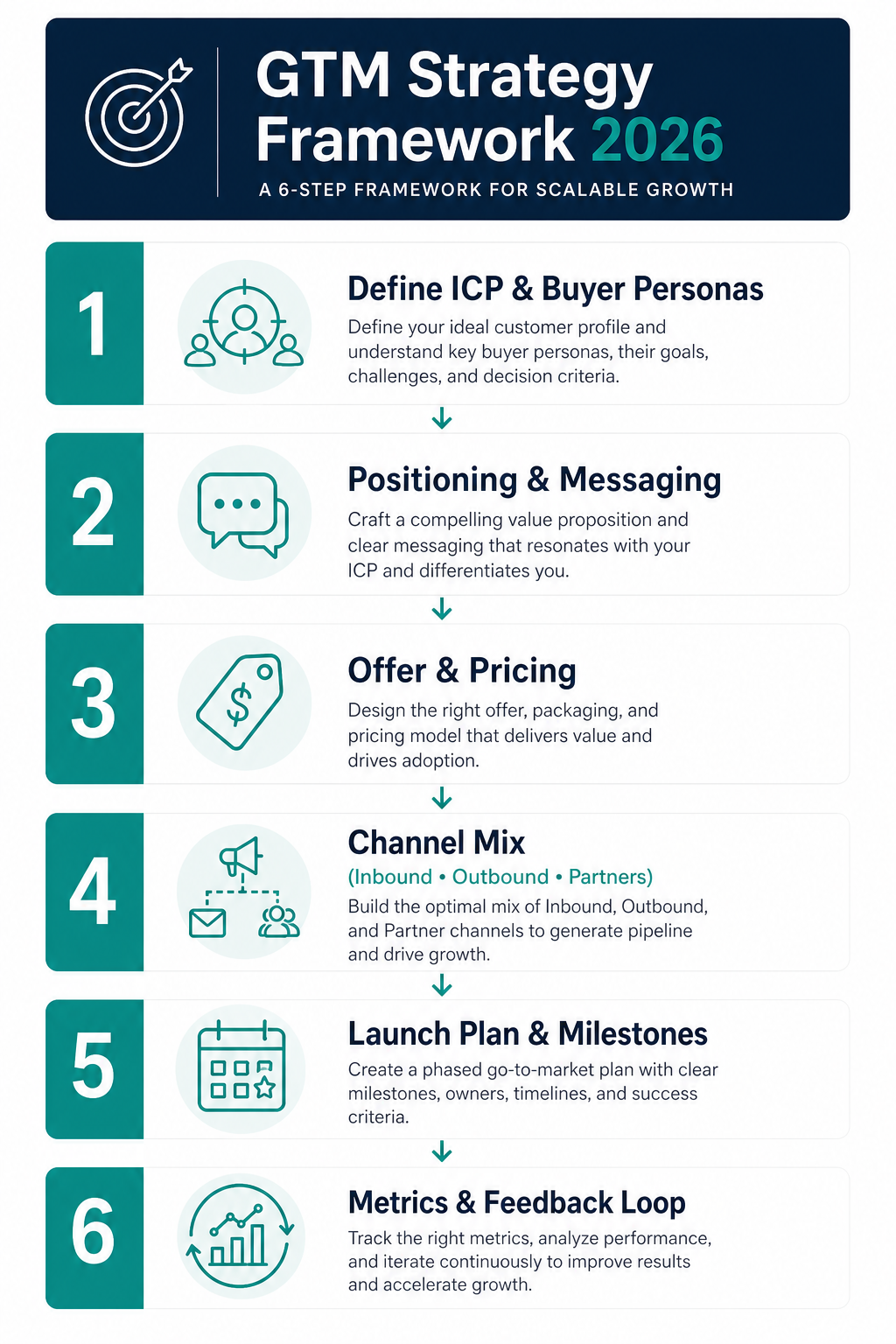
Use this six-step sequence to build or refresh your plan. It matches the framework in the infographic above.
Step 1: Define ICP and buyer map
Write a one-page ICP: target segment, must-have triggers, disqualifiers, and success criteria after purchase. Interview five to ten customers or prospects. Capture objections and language they actually use. Translate that into a simple account and persona map your whole team can recite.
Step 2: Lock positioning and narrative
Draft a positioning statement and a message house: umbrella claim, three supporting pillars, and proof points. Create persona variants for champion and economic buyer. Pressure-test messaging in sales calls before scaling paid spend.
Step 3: Shape the offer and commercial model
Decide entry offer, expansion path, and what is included at each tier. Clarify implementation burden. If buyers need hand-holding, budget services or partner delivery into the GTM plan. Price for value, then validate willingness-to-pay with real conversations.
Step 4: Choose channel mix and operating cadence
Select one primary acquisition engine. Example: inbound content plus demo requests for mid-market SaaS, or outbound plus webinars for high-ACV enterprise. Define weekly production cadence, owners, and budgets. Add secondary channels only after the primary motion produces repeatable pipeline.
Step 5: Build the launch and enablement plan
Create a 30/60/90-day plan: assets, landing pages, sequences, sales enablement, partner briefs, and launch events. Enablement is part of GTM — if sales cannot tell the story consistently, marketing spend leaks. Include internal launch so support and CS know what changed.
Step 6: Measure, learn, and iterate
Set leading indicators (qualified pipeline created) and lagging indicators (revenue, retention). Run experiments on messaging, offers, and channels with clear hypotheses. Kill what does not move the metric. Double down where conversion improves. Treat GTM as a product with continuous releases.
GTM Motions: Choosing How You Sell
Product-led growth (PLG)
Users adopt through product experience first. GTM emphasizes activation, onboarding, viral loops, and upgrade triggers. Best when time-to-value is short and the product can demonstrate value without a salesperson.
Sales-led growth
Complex deals need discovery, demos, security reviews, and multi-threading. GTM emphasizes outbound, ABM, events, and sales enablement. Best for high ACV and multi-stakeholder buying committees.
Hybrid and partner-led motions
Many 2026 teams run hybrid: product-led entry with sales assist for expansion, or partner-led distribution into niches. The GTM document must specify which accounts get which motion and how handoffs work.
Common GTM Mistakes to Avoid
- Starting with channels before ICP: You amplify confusion faster.
- Too many personas at once: Diluted messaging and weak conversion.
- Launch theater without enablement: Announcements without sales readiness.
- Vanity metrics: Celebrating impressions while pipeline quality drops.
- No owner: GTM needs a clear DRI across marketing and revenue.
How to Write Your GTM Strategy Document
Keep the living GTM doc short enough that people use it. A practical outline:
- Objective and time horizon
- ICP, personas, and disqualifiers
- Positioning, messaging, and proof assets
- Offer, packaging, and pricing
- Primary and secondary channels with owners
- Sales motion, stages, and SLAs
- 30/60/90 launch plan
- Metrics, targets, and review cadence
Review the document every month for the first quarter after launch, then quarterly. Update when ICP, pricing, or channel economics change.
GTM Checklist for Founders and Growth Teams
Before you scale spend, confirm you can answer yes to these:
- We can describe our ICP in one paragraph.
- We have a differentiated narrative with proof.
- Pricing matches the buying motion.
- One primary channel has an owner and weekly cadence.
- Sales and marketing share a qualified-lead definition.
- We track conversion by stage and review weekly.
Conclusion
A go-to-market strategy is how you systematically create demand, convert it, and learn faster than competitors. In 2026, the winners treat GTM as an integrated system — ICP, messaging, offer, channels, sales motion, and metrics — not a campaign calendar. Start with focus, instrument the funnel, and iterate with discipline.
If you are building or refreshing your GTM for a SaaS or service business, use the framework above as your operating map: define the buyer, sharpen the story, pick a motion you can execute, launch with enablement, and let the numbers tell you what to do next.
