Go-To-Market
GTM Planning Template
A GTM planning template with six sections — objectives, ICP, positioning, channels, launch plan, and metrics — plus how to use it to run a launch in 30 days.
TheGrowthStacker Team7 min read
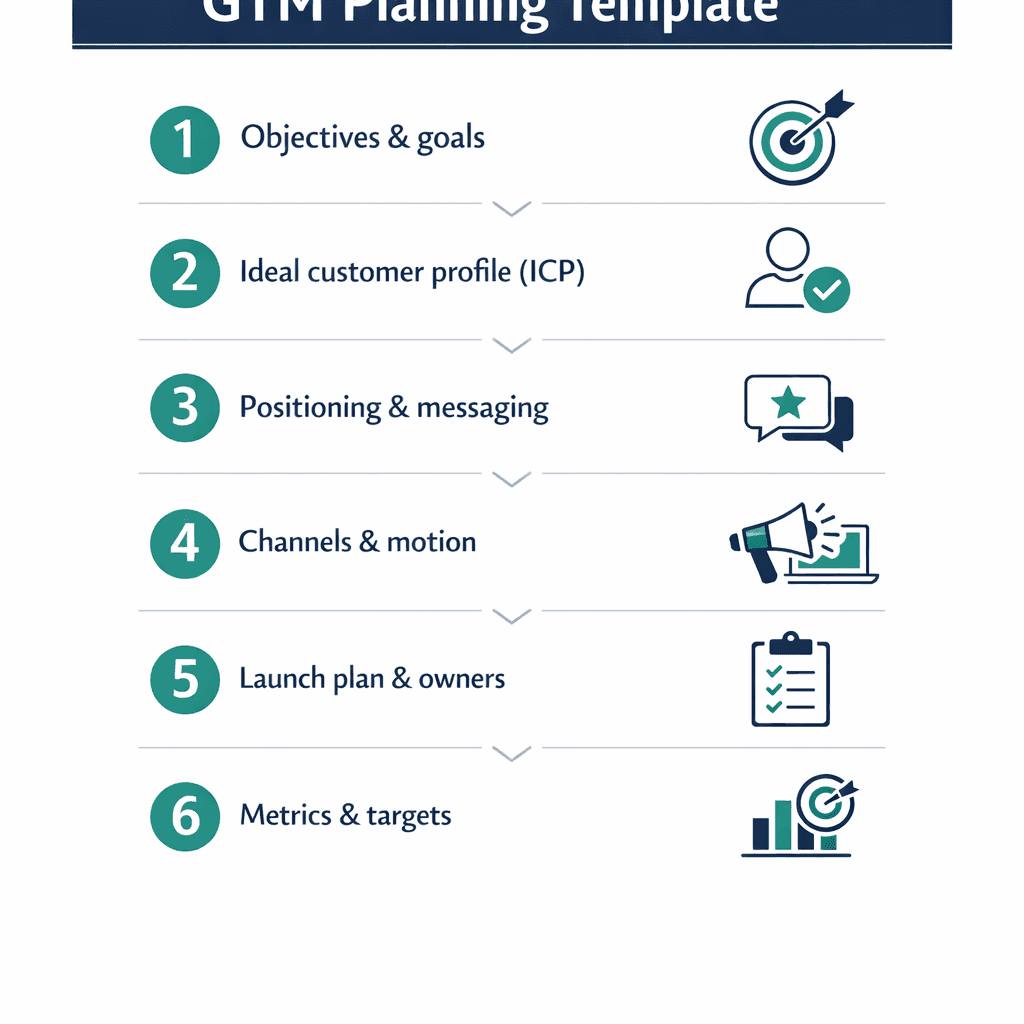
A GTM planning template is a reusable document that captures the decisions behind a go-to-market motion in one place: goals, target customer, positioning, channels, launch plan, and the metrics you will hold yourself to. It replaces scattered slides and Slack threads with a single source of truth the whole team can act on. This guide is for founders, growth leads, and RevOps owners who want a repeatable structure instead of reinventing the plan for every launch.
Below you will find the exact sections a strong GTM planning template contains, how to fill each one, and how to use the template to run a launch in 30 days. Copy the structure into a doc or sheet and adapt it — the value is in the discipline of answering each question, not in a fancy file. We keep every recommendation tied to pipeline and revenue, not vanity activity.
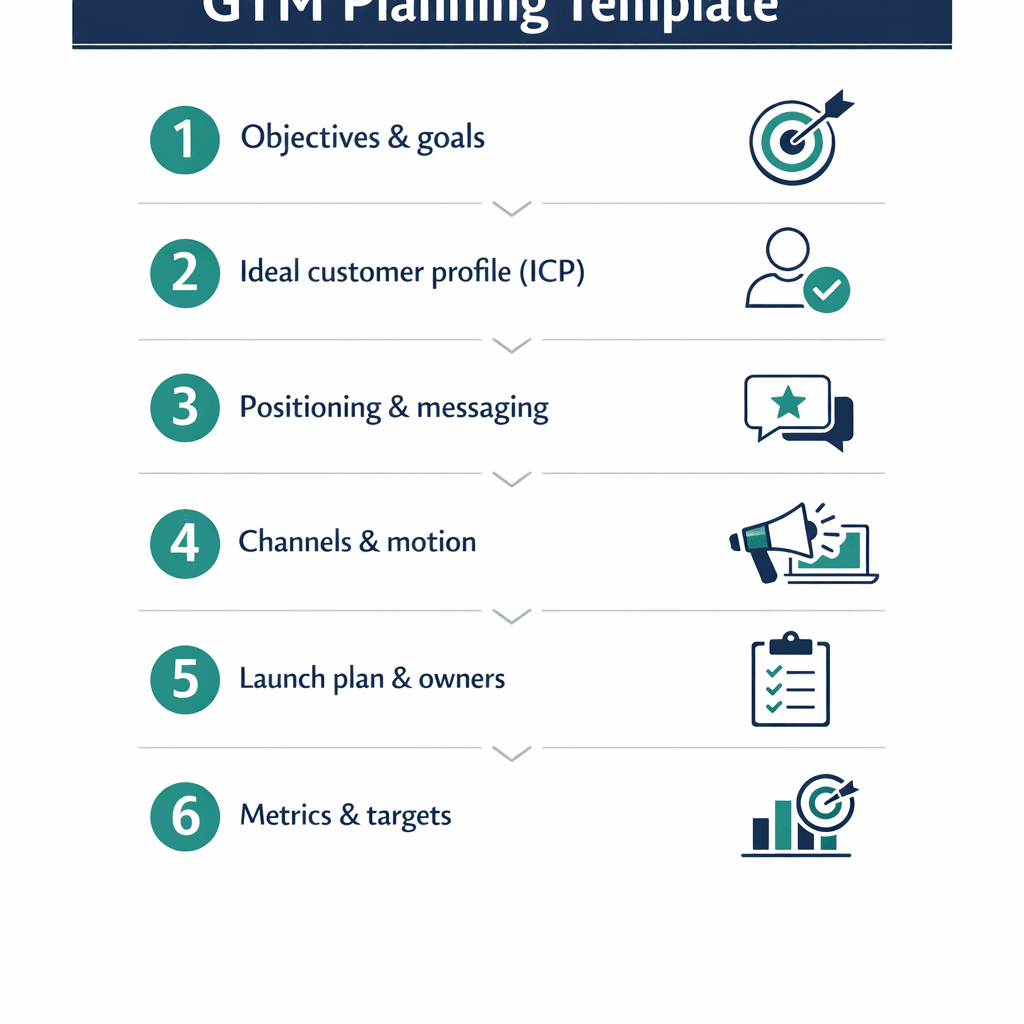
The six sections of a practical GTM planning template.
Key takeaways
- A GTM planning template forces one owner and one plan instead of scattered opinions.
- Six sections cover the whole motion: goals, ICP, positioning, channels, launch, and metrics.
- Tie every section to pipeline or revenue, and name a single owner per line.
- Treat it as a living operating document you review weekly, not a one-time deliverable.
What a GTM planning template is (and is not)
A GTM planning template is a working document, not a pitch deck. Its job is to make decisions explicit and hold owners accountable, so anyone on the team can read it and know what you are launching, to whom, through which channels, and how you will judge success. A good template is short enough to keep current and specific enough to act on.
It is not a strategy essay or a one-time exercise. The template should live in a shared doc or sheet, get reviewed at least monthly, and change as you learn. If a section cannot be answered in a few sentences, that is a signal the underlying decision is not made yet — which is exactly what the template is meant to surface before you spend budget.
The six sections of a GTM planning template
These six sections map to the infographic above. Fill them in order, because each one constrains the next: your goal shapes who you target, which shapes how you position, which shapes the channels you pick.
Objectives and goals
State one primary objective with a number and a date — for example, “$500k in new pipeline by end of Q3.” Add two or three supporting goals at most. If everything is a priority, nothing is, and the rest of the plan loses focus. Write the objective where the whole team can see it, because every later section should trace back to it; if a channel or campaign does not move this number, it does not belong in the plan.
Ideal customer profile (ICP)
Define the ICP by firmographics (industry, size, region), the trigger that makes them ready to buy, and the buying committee you must win. Be specific enough that a rep or a campaign can tell in seconds whether an account fits.
Positioning and messaging
Write the category you compete in, your core differentiation, and the one-line value each buyer role should remember. Give the champion language they can repeat internally, because in most B2B deals someone else has to sell it for you when you are not in the room.
Channels and motion
Choose your motion — sales-led, product-led, or hybrid — and the two or three channels you will actually resource. It is better to run two channels well than six poorly. Note the expected role of each channel: awareness, pipeline, or conversion.
Launch plan and owners
Lay out milestones, dependencies, and a named owner for each. A launch stalls on the unowned task, not the hard one, so every line needs a person and a date. Keep it to the milestones that actually gate the launch.
Metrics and targets
Pick the few metrics that reflect revenue: pipeline created, conversion rate by stage, CAC, and the leading signals you will watch weekly. Avoid vanity metrics like impressions that never tie back to a deal. Set a target and a review cadence for each.
How to use the template to run a launch in 30 days
Draft the whole template in week one, even if some answers are rough. A complete rough plan beats a perfect half-plan because it exposes gaps early. In week two, pressure-test the ICP and positioning with a few real prospects or recent closed-won and closed-lost notes, then tighten the wording.
Weeks three and four are execution: stand up the two chosen channels, brief the team from the template, and start tracking the metrics. Review the plan at the end of each week, update owners and targets, and note what the early data is telling you about the ICP and messaging. If a channel is clearly underperforming after two weeks, cut it and redirect the effort rather than waiting out the quarter. The template becomes your operating cadence, not a document you file and forget.
Example: a seed-stage SaaS filling the template
Consider an illustrative seed-stage SaaS selling a reporting tool to finance teams. Their objective is $300k in new pipeline in one quarter. Their ICP is 50–200-person B2B companies where a controller owns the buying decision and the trigger is a messy month-end close. Positioning centers on “close the books three days faster,” with a controller-facing value line and a CFO-facing one.
They pick two channels — founder-led outbound to controllers and a partnership with an accounting community — and skip paid ads for now. The launch plan names the founder as owner of outbound and the head of growth as owner of the partnership, each with weekly milestones. Metrics are meetings booked, pipeline created, and reply-to-meeting rate. Because every line has an owner and a number, the weekly review takes fifteen minutes and surfaces slippage fast.
My Insights
In GTM work, the teams that win with a planning template treat it as a forcing function, not paperwork. The value is not the file — it is that filling each section forces a decision you were quietly avoiding, usually a fuzzy ICP or a positioning line no one can repeat. When a template is hard to fill, that friction is the insight; do not skip the section, resolve the decision.
The second thing that separates a living plan from a dead one is ownership and metrics on every line. Plans die in the passive voice — “marketing will drive awareness” — because no one is accountable. Assign a name and a number to each row, review weekly, and cut any metric that does not connect to pipeline. A shorter GTM planning template that people actually update beats an exhaustive one that rots in a drive.
Frequently Asked Questions
What should a GTM planning template include?
A GTM planning template should include six sections: objectives and goals, ideal customer profile, positioning and messaging, channels and motion, a launch plan with owners, and metrics with targets. Keep each section short and specific, and make sure every line ties to pipeline or revenue and has a named owner.
Who owns the GTM planning template?
One person should own the template — usually a founder at early stage or a head of growth or RevOps later. That owner keeps it current and runs the weekly review, while each line inside the plan has its own owner. Shared ownership of the whole document tends to mean no one maintains it.
How is a GTM plan different from a marketing plan?
A GTM plan covers the entire route to revenue — target market, positioning, sales and product motions, and channels — while a marketing plan usually covers only demand and awareness activities. The marketing plan is one input to the broader GTM plan, not a replacement for it.
How often should you update the template?
Review it weekly during an active launch and at least monthly the rest of the time. Update owners, targets, and any section where new customer evidence changes your assumptions. The template is only useful if it reflects reality, so treat it as a living operating document rather than a one-time deliverable.
Do early-stage startups need a GTM planning template?
Yes. Early stage is when focus matters most, and a lightweight template keeps a small team from spreading across too many channels and personas. Keep it to one page, revisit it often, and let it grow as you learn what actually generates pipeline.
Ready to build a GTM plan that actually drives pipeline?
Request a service consultation — we will review your GTM funnel, identify gaps, and outline a plan you can execute in the next 30 days.
Want help putting this into practice?
Get a free proposal and a clear plan for your go-to-market.
Keep reading

AI-Powered Go-to-Market Strategy
An AI-powered go-to-market strategy in four layers: data and signals, prioritization, messaging, and the feedback loop — plus a 90-day build sequence.
Aug 14, 2026 · 7 min read

Customer Journey Mapping for GTM
Customer journey mapping for GTM in four steps: stage by buyer decision, build from deal evidence, attach conversion rates, and ship one fix that moves pipeline.
Aug 10, 2026 · 7 min read

Market Segmentation for B2B Companies
B2B market segmentation that changes what you actually do: build segments from revenue data, score them, fund three to five, and measure pipeline by segment.
Aug 6, 2026 · 7 min read