
Go-To-Market
How to Create a GTM Strategy Step-by-Step
How to create a GTM strategy step-by-step — validate buyers, define ICP, craft positioning, pick channels, launch with enablement, and iterate with metrics.
TheGrowthStacker Team6 min read
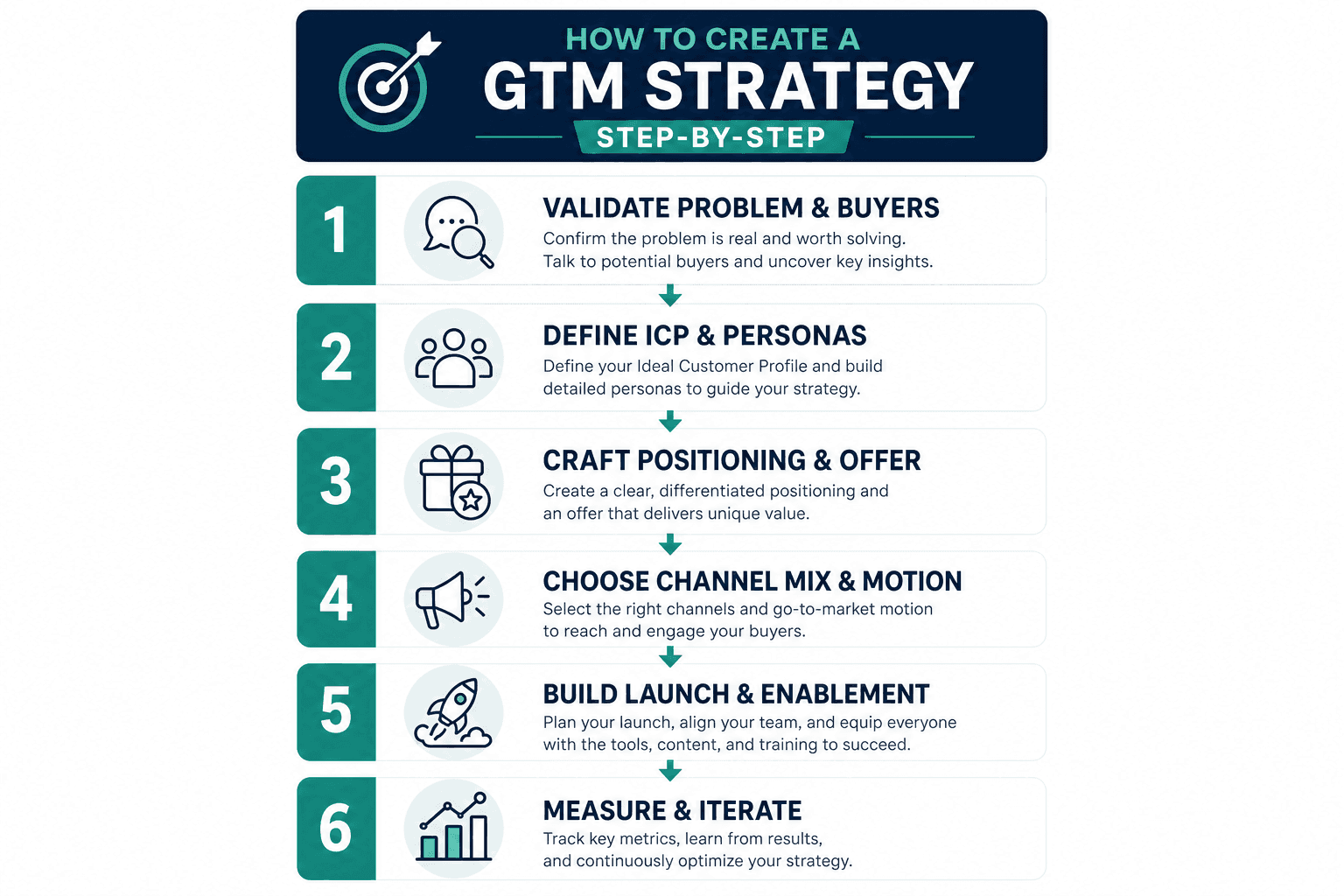
How to Create a GTM Strategy Step-by-Step
Most go-to-market plans fail before launch because teams skip sequence. They pick channels first, write messaging in a vacuum, or copy a competitor’s funnel without validating who actually buys. If you want revenue predictability, you need to know how to create a GTM strategy step-by-step — a repeatable process that turns research into positioning, positioning into motion, and motion into measured pipeline.
This guide walks you through a six-step GTM creation process used by founders, growth leads, and RevOps teams: validate buyers, define ICP, craft positioning and offer, choose channels and sales motion, build launch enablement, and instrument metrics for iteration. You will also get practitioner insights, FAQs, and a practical template outline you can run in 30–90 days.
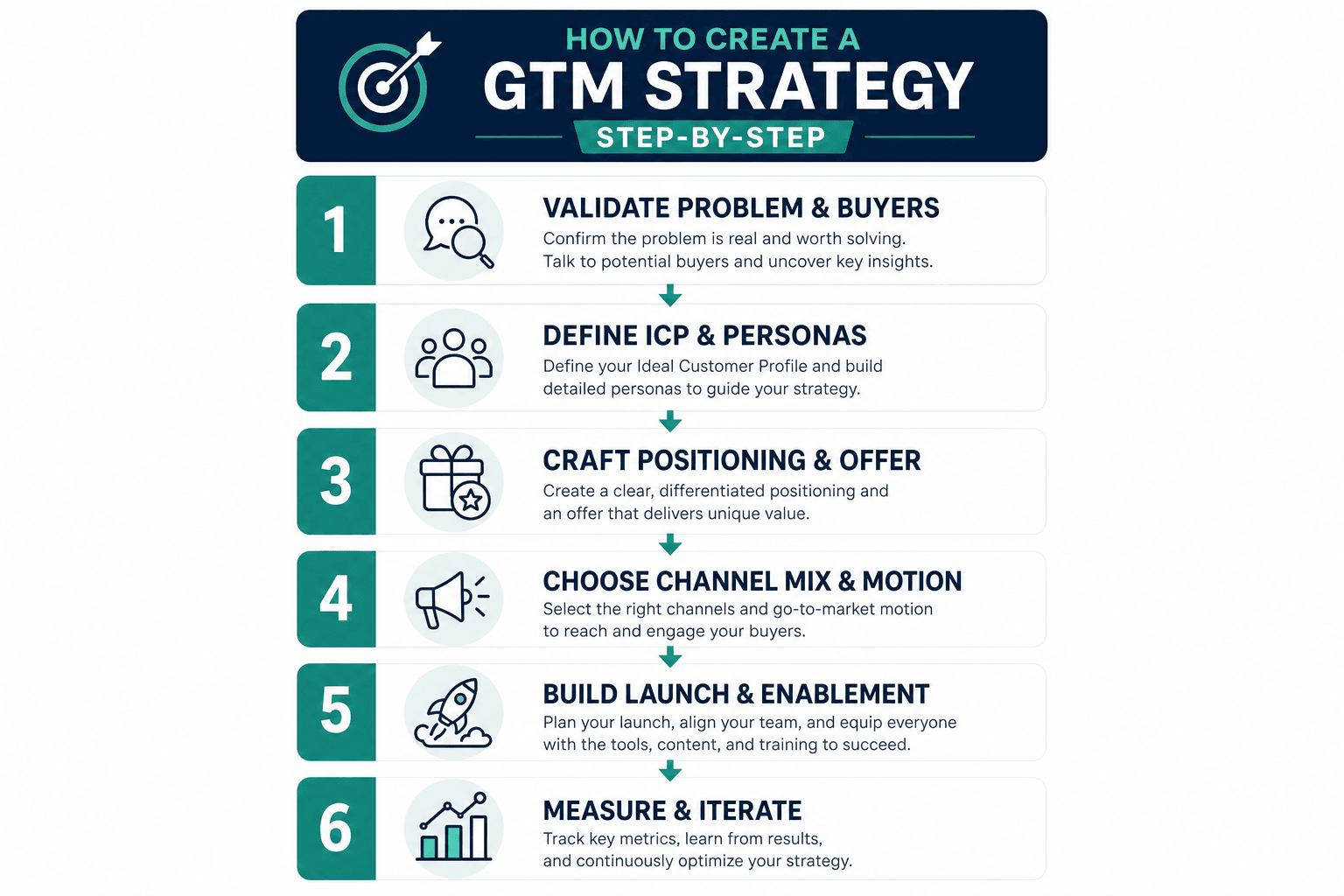
How to Create a GTM Strategy Step-by-Step — from buyer validation to launch and iteration.
Why a Step-by-Step GTM Process Matters
GTM is not a slide deck exercise. It is the operating system that connects product, marketing, sales, and customer success to one commercial outcome: qualified pipeline that closes and expands. When teams follow a step-by-step GTM process, they reduce rework, align handoffs, and spot weak assumptions before budget is spent.
Strategy vs activity
Activity looks busy: more ads, more posts, more outbound lists. Strategy answers sharper questions: who buys, why now, through which motion, at what price, with what proof. Without that clarity, activity generates noise — traffic without intent, demos without budget, and sales cycles that stall after pricing.
What you need before you start
Before you create a GTM strategy, gather inputs: product access or a clear prototype, five to fifteen buyer conversations, basic competitive context, and one owner who can make tradeoffs. You do not need perfect data. You need enough signal to choose a narrow ICP and a testable motion.
How to Create a GTM Strategy Step-by-Step
Use this six-step sequence as your default playbook. Each step produces an artifact the next step depends on — skip one and downstream work gets expensive.
Step 1: Validate the problem and buyers
Start with problem validation, not channel selection. Interview prospects and recent customers. Capture the job they hire your product to do, urgency triggers, alternatives they consider, and objections that kill deals. Document exact phrases buyers use — those phrases become messaging later. Exit criteria: you can name a segment that feels the pain weekly and pays to fix it.
Step 2: Define ICP and buyer map
Turn research into a one-page ideal customer profile: industry, company size, tech context, trigger events, and disqualifiers. Map personas inside the account — economic buyer, champion, user, and blocker. B2B GTM fails when messaging speaks to users while budget lives with a different role. Your ICP should be narrow enough to build a target list in an afternoon.
Step 3: Craft positioning and offer
Positioning is the slot you occupy versus alternatives — including spreadsheets, agencies, or doing nothing. Write a positioning statement and message house: umbrella claim, three pillars, proof points. Shape the offer: packaging tiers, onboarding, implementation, and pricing model aligned to ACV and sales motion. Misaligned pricing is a GTM bug that no amount of ads fixes.
Step 4: Choose channel mix and sales motion
Pick one primary acquisition engine you can execute with quality — inbound plus demos, outbound plus ABM, partnerships, product-led trials, or events. Add at most one secondary channel. Define the sales motion: self-serve, sales-assisted, or enterprise multi-threading. Document qualification criteria and SLAs between marketing and sales so pipeline quality is shared, not debated.
Step 5: Build launch plan and enablement
Translate strategy into a 30/60/90-day launch plan: landing pages, sequences, ads, webinars, partner briefs, and sales enablement assets. Enablement is part of GTM — if reps cannot tell the story consistently, spend leaks. Include internal launch so support and customer success know what changed, what promises are made, and how to handle edge cases.
Step 6: Instrument metrics and iterate
Define leading indicators (qualified pipeline created) and lagging indicators (win rate, CAC payback, retention). Review weekly in a GTM cadence. Run experiments on messaging, offers, and channels with written hypotheses. Kill what does not move metrics; double down where conversion improves. Treat GTM as a product with continuous releases, not a one-time launch.
GTM Strategy Document Template
Keep your living GTM doc short enough that people actually use it. If it is forty pages, it will live in a folder while the team improvises.
What to include on one page
- Objective and 90-day horizon
- ICP, personas, and disqualifiers
- Positioning, messaging, and proof assets
- Offer, packaging, and pricing
- Primary channel, owner, and weekly cadence
- Sales motion, stages, and handoff rules
- Metrics, targets, and review schedule
Common shortcuts that fail
Teams often copy competitor websites, target “everyone in SaaS,” or launch campaigns before sales enablement exists. Sequence exists to prevent those errors.
My Insights
After running GTM engagements for SaaS and service businesses, the pattern is consistent: teams that win go uncomfortably narrow on ICP for the first 90 days. They would rather dominate one segment than speak vaguely to five. Narrow ICP makes channel choice obvious, sharpens proof requirements, and shortens sales cycles because buyers feel you built for them.
The second insight is that enablement is where most “strategies” die. Marketing produces assets; sales never uses them because discovery questions, objection handling, and pricing talk tracks were never aligned. When we create a GTM strategy step-by-step with clients, Step 5 gets as much calendar time as Step 4 — launch without enablement is just expensive awareness.
Frequently Asked Questions
What is the first step when you create a GTM strategy step-by-step?
Start with buyer and problem validation through interviews — not channel planning. Confirm that a specific segment has urgent pain, budget, and a reachable buying process. Everything else — ICP detail, messaging, channels — builds on that evidence.
How long does it take to build a GTM strategy?
A focused team can produce a v1 GTM plan in two to four weeks with daily ownership. Execution and iteration run for 90 days before you should scale spend. Enterprise motions with long cycles may need longer validation, but the sequence stays the same.
Who should own GTM strategy creation?
Assign one directly responsible individual — often the founder, head of growth, or VP Revenue — with authority to align marketing, sales, and product tradeoffs. Committees write documents; owners ship motions.
How is SaaS GTM different from other B2B GTM?
SaaS GTM often blends product-led trials with sales-assisted expansion. That means your step-by-step plan must define activation milestones, upgrade triggers, and when human sales engages — not only top-of-funnel campaigns.
What tools do you need for a GTM strategy?
At minimum: CRM, analytics on site and product, a shared doc for the GTM plan, and call recording or notes for win-loss learning. Advanced stacks add intent data, marketing automation, and forecasting — but tools never replace ICP clarity.
Conclusion
Learning how to create a GTM strategy step-by-step gives your team a shared language for revenue decisions. Validate buyers, narrow ICP, sharpen positioning, choose a motion you can execute, launch with enablement, and iterate with honest metrics. That sequence beats random campaigns every time.
Start with Step 1 this week — five buyer conversations will teach you more than a day of channel brainstorming. Build the plan in order, and let pipeline quality tell you when to scale.
Ready to build your GTM strategy step-by-step?
Request a service consultation — we will review your funnel, identify gaps, and outline a go-to-market plan you can execute in the next 30 days.
Want help putting this into practice?
Get a free proposal and a clear plan for your go-to-market.
Keep reading

AI-Powered Go-to-Market Strategy
An AI-powered go-to-market strategy in four layers: data and signals, prioritization, messaging, and the feedback loop — plus a 90-day build sequence.
Aug 14, 2026 · 7 min read

Customer Journey Mapping for GTM
Customer journey mapping for GTM in four steps: stage by buyer decision, build from deal evidence, attach conversion rates, and ship one fix that moves pipeline.
Aug 10, 2026 · 7 min read

Market Segmentation for B2B Companies
B2B market segmentation that changes what you actually do: build segments from revenue data, score them, fund three to five, and measure pipeline by segment.
Aug 6, 2026 · 7 min read