

How AI is Transforming Go-to-Market Strategy
Go-to-market strategy used to be a quarterly planning exercise: define your ideal customer, write positioning, pick channels, and hope the funnel cooperated. In 2026, AI is reshaping every layer of that system — from how teams identify intent and craft messaging to how they forecast pipeline, enable sales, and learn from closed deals. The shift is not “replace your GTM team with chatbots.” It is a new operating model where AI compresses research cycles, surfaces patterns humans miss, and lets lean revenue teams run motions that previously required large headcount.
This guide explains how AI is transforming go-to-market strategy today: the core shifts, practical use cases across marketing and sales, the stack and guardrails you need, common pitfalls, and how to adopt AI in GTM without losing focus or credibility.
Why AI Changes GTM Now
GTM has always been constrained by information and bandwidth. Teams could not interview every prospect, personalize every touch at scale, or re-score pipeline daily by hand. AI removes parts of that constraint — not by automating judgment, but by making research, drafting, scoring, and synthesis cheap enough to run continuously.
From periodic planning to continuous GTM
Traditional GTM documents aged quickly. Markets shifted, competitors repositioned, and messaging drifted from what buyers actually said on calls. AI-assisted GTM treats positioning, content, outbound sequences, and account lists as living artifacts that update when new call transcripts, win-loss notes, and search trends arrive. The strategy still has an owner — but the system learns weekly instead of quarterly.
Buyers already use AI — your GTM must respond
Prospects research vendors through search, communities, and AI assistants. They expect crisp category language, proof, and self-serve evaluation paths. GTM teams that ignore AI-mediated discovery lose visibility before the first demo request. AI transformation in GTM includes how you show up in search and answer engines, not only how you run internal tools.
Six Ways AI Is Reshaping GTM
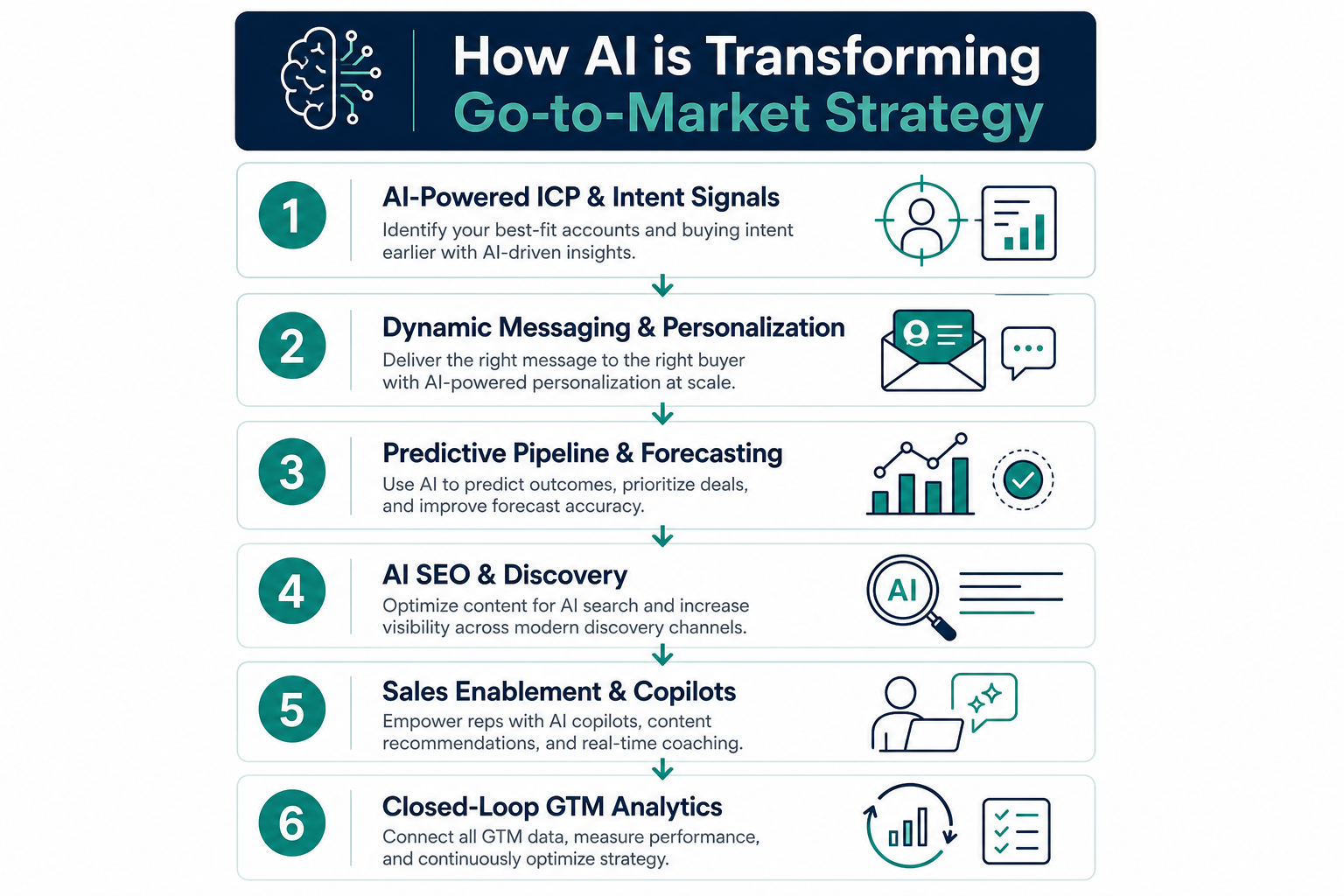
The infographic above maps the highest-impact shifts. Here is how each area works in practice.
1. AI-powered ICP and intent signals
Instead of static firmographic lists, modern teams combine first-party data, product usage, content engagement, and third-party intent feeds. AI clusters accounts that behave like your best customers and flags in-market signals — job changes, tech stack shifts, funding, hiring patterns, and topic surges. The output is not “more leads.” It is a prioritized account list with reasons attached, so outbound and ABM spend concentrate on accounts that actually fit.
2. Dynamic messaging and personalization
Positioning still needs human approval, but AI accelerates the work around it: persona variants, landing page drafts, email sequences, ad copy tests, and objection-handling snippets grounded in your message house. Strong teams use templates and guardrails so AI output stays on-brand. Personalization moves from mail-merge fields to segment-specific narratives tied to industry pain, role, and funnel stage.
3. Predictive pipeline and forecasting
CRM data is messy; forecasts lie when reps optimistic-guess. AI models score deals using historical patterns — stage velocity, stakeholder engagement, email sentiment, meeting cadence, and competitive mentions — to highlight at-risk opportunities and likely closes. Revenue leaders get earlier warnings and can coach with evidence instead of gut feel alone.
4. AI SEO and discovery
Organic discovery is a GTM channel, not a side project. AI helps teams map topic clusters, draft authoritative content outlines, optimize for intent-rich queries, and structure pages for both traditional search and AI answer surfaces. The goal is qualified demand: pages that attract buyers researching problems you solve, with clear paths to trials, demos, or consultations.
5. Sales enablement and copilots
AI copilots summarize calls, extract next steps, draft follow-ups, and suggest talk tracks aligned to persona and deal stage. Enablement teams turn winning conversations into playbooks faster. Reps spend less time on admin and more on discovery — if the organization invests in review and quality control so copilots do not send generic or inaccurate outreach.
6. Closed-loop GTM analytics
The biggest GTM upgrade is closing the loop: which messages, channels, and segments produce revenue — not just MQLs. AI helps attribute multi-touch journeys, analyze win-loss themes at scale, and recommend budget shifts. When product, marketing, and sales share one feedback system, GTM becomes iterative product management for revenue.
A Practical AI-Enabled GTM Workflow
Adoption fails when teams buy tools before defining motion. Use this sequence to integrate AI without chaos.
Week 1–2: Clarify ICP and data foundations
Document ICP, personas, disqualifiers, and current funnel metrics. Clean CRM fields, unify UTM conventions, and capture call notes in a searchable system. AI is only as good as the inputs and labels you feed it.
Week 3–4: Pilot one high-leverage use case
Pick a single pain point: outbound research, content briefs, call summaries, or lead scoring. Run a two-week pilot with clear success metrics — hours saved, reply rates, qualified meetings, or forecast accuracy. Avoid launching six AI tools at once.
Month 2: Add guardrails and human review
Create prompt libraries, brand voice rules, and approval steps for customer-facing output. Require human review on messaging, pricing claims, and outbound until quality is proven. Automate internal drafts first; external sends second.
Month 3+: Scale across the revenue team
Connect insights back to positioning, offers, and channel mix. Train marketing, SDRs, AEs, and CS on the same definitions of qualified pipeline. Expand AI use where pilots showed measurable lift — and kill what did not move numbers.
Stack and Guardrails for AI GTM
What to connect
A workable stack usually includes your CRM, product analytics, conversation intelligence, marketing automation, content/SEO tooling, and a secure workspace for prompts and knowledge bases. Integrations matter more than novelty — if AI insights do not flow into daily workflows, adoption dies.
Governance that protects trust
Define what data can enter models, how customer information is handled, and who approves external communications. Ban unreviewed bulk outreach. Monitor for hallucinated claims, especially in regulated or competitive categories. Trust is a GTM asset; AI spam destroys it quickly.
Common Mistakes When Adding AI to GTM
- Tool-first, strategy-last: Buying platforms before ICP and messaging are clear amplifies noise.
- Vanity automation: Generating more content or emails without improving conversion.
- Removing humans from positioning: AI drafts; leaders still own category narrative and proof.
- Ignoring data hygiene: Bad CRM hygiene produces bad scores and false confidence.
- No shared metrics: Marketing celebrates volume while sales chases quality — same failure as pre-AI GTM.
Where AI GTM Creates the Fastest Wins
Not every GTM job benefits equally from AI on day one. High-velocity wins usually appear in research-heavy workflows: building account briefs, drafting first-pass landing pages, summarizing discovery calls, and producing SEO content briefs aligned to buyer intent. Mid-market and enterprise teams also see lift in lead scoring and forecast hygiene when CRM data is reasonably clean. Slower wins — fully autonomous outbound or brand-new category creation — still need strong human leadership. Prioritize automation where repetition is high and judgment calls are bounded.
PLG, sales-led, and hybrid motions
AI adapts differently by motion. Product-led teams use AI to personalize onboarding, trigger upgrade nudges, and analyze activation drop-offs. Sales-led teams lean on copilots for prep, follow-up, and multi-threading reminders. Hybrid motions need explicit rules for when product signals escalate to sales — otherwise AI creates noise instead of pipeline. Document handoff criteria the same way you document MQL definitions.
Measuring ROI of AI in GTM
Track outcomes, not activity. Useful metrics include qualified pipeline created per rep, meeting-to-opportunity conversion, content-assisted revenue, sales cycle length, forecast accuracy, CAC payback, and win-rate shifts by segment. Pair quantitative metrics with qualitative checks: Are reps trusting the tools? Is messaging sharper? Are customers receiving more relevant experiences?
How The Growth Stacker Helps
The Growth Stacker helps SaaS and service businesses build AI-enabled GTM systems that produce qualified leads — not just dashboards. That includes ICP and positioning work, AI SEO and content architecture, funnel design, performance marketing, and sales-aligned enablement so marketing and revenue operate from one plan.
If you want to modernize your go-to-market with AI without losing focus or brand credibility, we can map your current funnel, recommend high-ROI automations, and help you ship a pilot in weeks.
Conclusion
AI is transforming go-to-market strategy from a static plan into a continuous, instrumented revenue system. Teams that win will not be the ones with the most AI tools — they will be the ones with clear ICP, strong messaging, disciplined review, and closed-loop learning powered by AI where it actually saves time and improves conversion.
Start narrow, measure honestly, and expand what works. GTM still rewards focus; AI just lets focused teams move faster.
Ready to build an AI-powered GTM strategy?
Request a service consultation — we will review your funnel, identify high-impact AI use cases, and outline a go-to-market plan you can execute in the next 30 days.
