

Product Launch Strategy vs Go-to-Market Strategy
Teams often treat a product launch and a go-to-market strategy as the same thing. They are not. A launch is a coordinated moment — press, campaigns, enablement, and internal readiness for a specific release. A go-to-market strategy is the longer-lived operating system that defines who you sell to, how you reach them, what you charge, and how you measure pipeline from first touch to expansion. Confusing the two leads to launch theater: big announcements, weak revenue follow-through.
This guide explains product launch strategy vs go-to-market strategy — how they differ, how they connect, when you need each, and a practical framework to align launch plans inside a durable GTM system. You will also get practitioner insights, FAQs, and a checklist to avoid the most common mistakes.
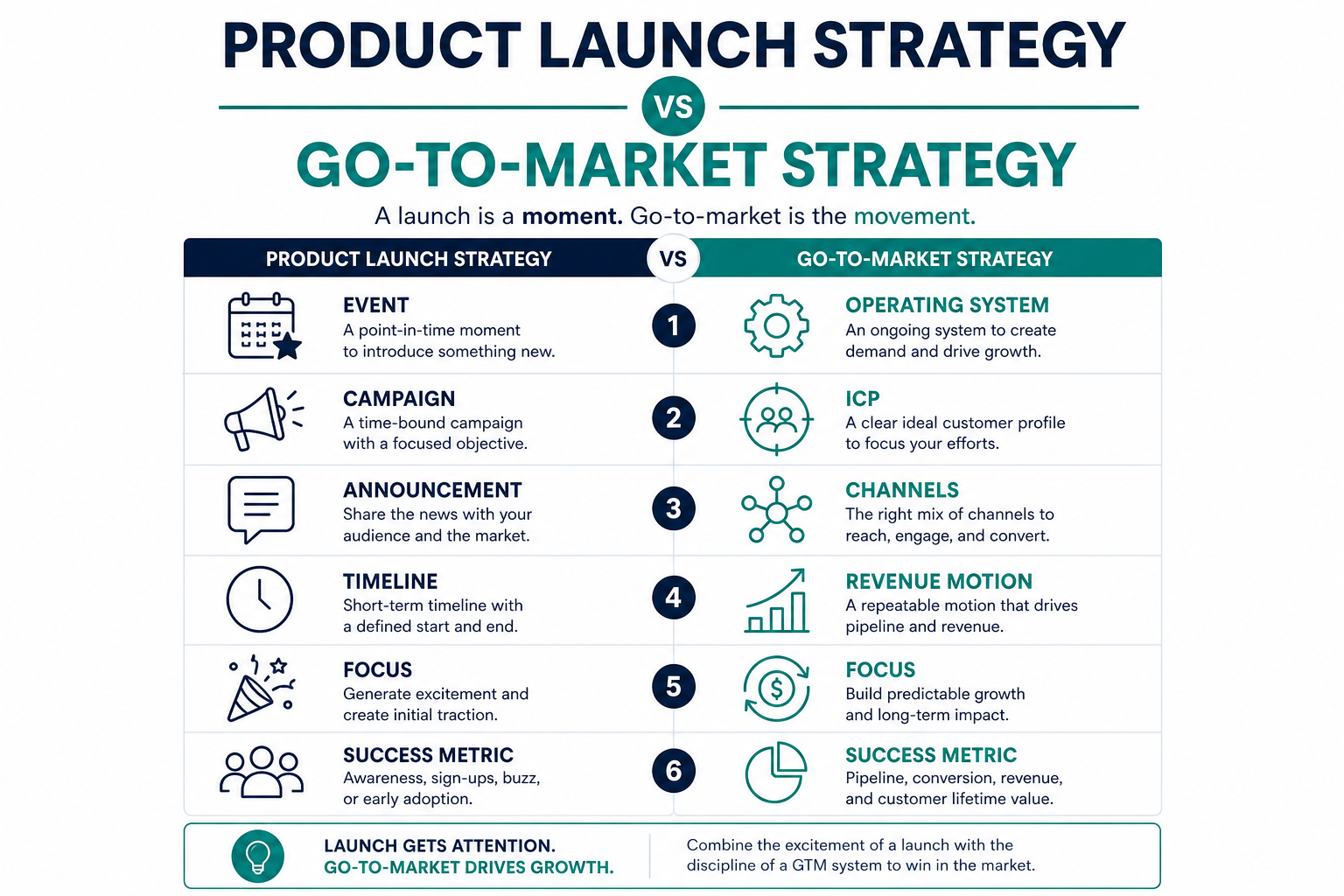
Product Launch Strategy vs Go-to-Market Strategy: The Core Difference
A product launch strategy answers: how do we introduce this release to the market on a defined timeline with coordinated messaging and assets? A go-to-market strategy answers: how does this company repeatedly create demand, convert it, and learn — for this offer and segment over quarters, not weeks.
Launch = event; GTM = system
Launches have start and end dates. They include announcement timing, campaign bursts, PR, webinars, and sales kickoffs tied to a version or feature set. GTM has no finish line. It includes ICP, positioning, channel mix, sales motion, pricing, enablement, and metrics that persist across multiple launches.
Why the distinction matters for revenue
When teams only plan launches, they optimize for spikes — traffic, signups, press mentions — without building repeatable pipeline. When teams only plan abstract GTM, they under-invest in release moments that could accelerate adoption among existing accounts or re-engage stalled deals. You need both, with clear roles.
What Is a Product Launch Strategy?
A product launch strategy is the plan for bringing a specific product, feature, or version to market attention on a schedule. It coordinates marketing, product, sales, and support around a release window.
Typical launch components
- Launch narrative and messaging for the release
- Asset pack: landing pages, emails, ads, demo scripts
- Internal enablement and support readiness
- PR, community, or partner announcements
- Launch-day checklist and war-room cadence
Launch types
Launches vary by scope: net-new product, major version, feature add-on, geographic expansion, or repositioning. A minor feature update needs a lighter launch; a new category entry needs full GTM alignment plus a heavyweight launch motion.
What Is a Go-to-Market Strategy?
A go-to-market strategy is the commercial operating plan for an offer in a defined market. It outlasts any single launch and governs how revenue is created systematically.
Core GTM building blocks
- ICP, personas, and disqualifiers
- Positioning, messaging, and proof
- Offer, packaging, and pricing
- Channel strategy and sales motion
- Funnel metrics and feedback loops
GTM owns the motion; launch activates a moment
GTM decides whether you sell product-led, sales-led, or hybrid. It defines qualified pipeline and handoffs. A launch injects urgency and narrative into that motion — but cannot replace a broken ICP or misaligned pricing.
Side-by-Side Comparison
Use this table mindset when planning — the infographic above mirrors these contrasts.
Time horizon
Launch: weeks to a few months around a release date.
GTM: quarters to years, updated continuously as you learn.
Primary goal
Launch: awareness, adoption, and activation for a specific release.
GTM: repeatable revenue motion with measurable unit economics.
Success metrics
Launch: launch-window signups, demo requests, press coverage, feature adoption.
GTM: qualified pipeline, win rate, CAC payback, retention, expansion.
Owners
Launch: product marketing or launch lead with cross-functional squad.
GTM: revenue leader with marketing, sales, and product alignment.
How Launch and GTM Work Together
The strongest teams nest launch plans inside GTM — never the reverse.
Step 1: Validate GTM foundations first
Before a major launch, confirm ICP, positioning, pricing, and primary channel are tested. Launching a confusing offer loudly wastes budget and trains the market to ignore you.
Step 2: Define launch objectives tied to GTM metrics
Set launch goals that roll up to GTM KPIs — not vanity alone. Example: “500 qualified demo requests from ICP accounts in 30 days” beats “10k page views.”
Step 3: Run enablement before announcement
Sales and CS must know positioning, pricing changes, and objection handling before public launch. Internal readiness is part of launch strategy, not an afterthought.
Step 4: Feed launch learnings back into GTM
Capture win-loss themes, messaging performance, and channel conversion from the launch window. Update the living GTM doc — positioning, proof assets, and channel mix should improve after every release.
When You Need Which (or Both)
GTM without a big launch
Early-stage startups often need GTM clarity — narrow ICP, outbound or inbound motion, pricing tests — without a Product Hunt-style event. Quiet iteration beats launch theater when product-market fit is still forming.
Launch without refreshed GTM
Feature releases inside an established motion may need only a lightweight launch: changelog, email to users, sales one-pager. Full GTM rework is unnecessary if ICP and positioning still hold.
Both required
New product lines, category entries, enterprise tier launches, and geographic expansion need updated GTM plus a coordinated launch. Skipping either creates either silent releases or loud failures.
My Insights
In client work, the costliest mistake is treating every release like a launch and every launch like the whole GTM strategy. Not every sprint deserves a campaign. Reserve heavyweight launches for moments that change how you sell — new ICP, new pricing motion, or a capability that unlocks expansion. Everything else should ride the existing GTM engine with minimal friction.
Second, product marketing often owns the launch calendar while nobody owns the GTM doc. Fix that by giving GTM one DRI across revenue functions and letting launch squads execute timed activations inside it. When those roles blur, you get beautiful launch assets that sales never uses and pipeline that flatlines two weeks after announcement day.
Third, measure launch success by pipeline quality, not spike volume. A press hit that drives unqualified traffic is a distraction. Tie launch retros to SQL conversion and win-rate shifts in the target segment — that is how product launch strategy vs go-to-market strategy stays aligned instead of competing for credit.
Frequently Asked Questions
What is the difference between product launch strategy and go-to-market strategy?
A product launch strategy plans a timed release event with campaigns and enablement. A go-to-market strategy is the ongoing system for ICP, positioning, channels, sales motion, and revenue metrics. Launch is a chapter; GTM is the book.
Can you have a launch without a GTM strategy?
You can announce a product without a durable GTM plan, but results rarely repeat. One-time spikes without ICP clarity and channel discipline do not build predictable pipeline.
Which comes first — GTM or launch planning?
GTM foundations come first for major releases: ICP, positioning, pricing, and motion. Launch planning then schedules how you activate that strategy in market on a specific date.
Who owns product launch vs GTM strategy?
Launch is typically owned by product marketing with a cross-functional squad. GTM is owned by a revenue leader (founder, VP Growth, or VP Revenue) with authority across marketing, sales, and product.
How do SaaS companies align launch and GTM?
SaaS teams align by nesting launch goals inside GTM KPIs, running sales enablement before public announcement, and feeding launch conversion data back into positioning and channel decisions for the next cycle.
Ready to align your launch with a winning GTM strategy?
Request a service consultation — we will review your funnel, identify gaps, and outline a go-to-market plan you can execute in the next 30 days.
