

What a GTM checklist covers, and why it matters before launch
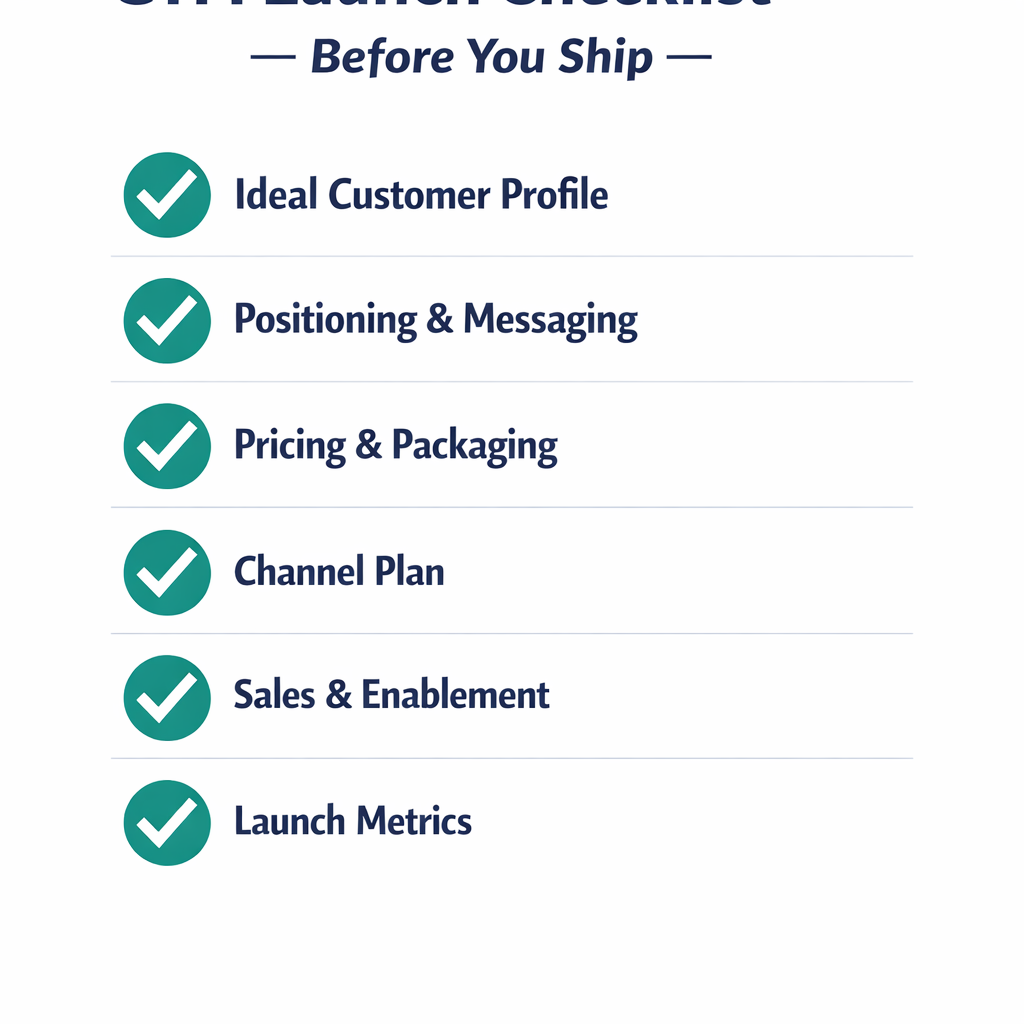
A GTM checklist is the short list of decisions you must lock before launching any product: who you are for, how you position, what you charge, where you will reach buyers, and how you will measure success. Work through it and you replace launch-day guesswork with a plan the whole team can execute. Skip it and you ship into silence, then spend the next quarter reverse-engineering why nobody bought.
This guide is for founders, growth leads, and RevOps teams preparing a launch. You will get a practical, revenue-focused GTM checklist, an illustrative example of how it plays out, and honest guidance on when to slow down. The goal is pipeline and revenue, not a busy launch-day dashboard of vanity metrics.
Key takeaways
- A GTM checklist forces the five decisions that determine launch outcomes: ICP, positioning, pricing, channels, and metrics.
- Start with the ideal customer profile; every later choice depends on knowing exactly who you serve.
- Pick one or two channels you can execute well rather than spreading effort across every option.
- Define pipeline and revenue targets before launch so you can tell a real result from noise.
Why product launches fail without a checklist
Most launches do not fail because the product is weak. They fail because the go-to-market work never happened. The team builds for months, sets a launch date, ships an announcement, and waits. Leads trickle in, sales has no clear story, and marketing cannot say which buyer the message is for. By the time anyone diagnoses the problem, momentum is gone and the launch is quietly written off as a soft one.
A checklist prevents this by turning launch readiness into explicit, owned decisions. Each item has an answer and a name attached to it, so nothing important stays vague until the week before. It also creates alignment: product, marketing, and sales work from the same definition of the buyer, the same message, and the same targets. That shared clarity, more than any single tactic, is what separates launches that build pipeline from launches that generate a spike of traffic and nothing else.
The GTM checklist before launching any product
Work these five decisions in order. Each one feeds the next, so resist the urge to jump ahead to tactics before the foundation is set.
Define your ideal customer profile
Your ideal customer profile (ICP) describes the specific company and buyer you serve best: segment, size, industry, the pain they feel, and the trigger that makes them buy now. Be narrow. A vague ICP produces vague messaging and scattered spend. Write down two or three concrete attributes you can actually target, such as “Series A B2B SaaS companies with a founder-led sales motion.” Everything downstream, from your message to your channel choice, depends on getting this right first.
Nail positioning and messaging
Positioning is the answer to “why this, for me, now.” State one clear value proposition, the alternative you replace, and two or three reasons to believe it. Then translate that into messaging your ICP would recognize as their own words, not internal jargon. Test the message on a handful of real buyers before launch; if they cannot repeat back what you do and why it matters, the message is not ready. Clear positioning makes every later channel cheaper because the copy converts.
Set pricing and packaging
Decide your tiers, price points, and what sits in each package before launch, not after leads arrive. Pricing signals who the product is for and shapes the sales conversation, so align it to the value your ICP gets, not to your costs. Keep the packaging simple enough that a buyer understands it in one glance. If you are unsure, start with a defensible price you can adjust rather than launching with no number and improvising on every call. A rough anchor beats silence, because it gives sales something concrete to test and lets you learn how buyers react instead of guessing.
Choose channels and enable sales
Pick the one or two channels where your ICP already spends attention, and commit to executing them well rather than dabbling in five. If sales is involved, give them the assets they need before launch: a short pitch, a demo flow, objection handling, and a clear definition of a qualified lead. A launch that sends traffic to a team with no enablement wastes the demand it creates. Match the channel to the motion, resource it properly, and make sure the handoff from marketing to sales is defined before the first lead arrives.
Example: an illustrative B2B SaaS launch
Consider an illustrative seed-stage SaaS company launching a workflow tool for RevOps teams. Working the checklist, they set the ICP as RevOps leads at 50-to-200-person B2B companies, position against manual spreadsheet reporting, and price a single mid-market tier they can defend on a call. They choose two channels, founder-led LinkedIn and a targeted partner webinar, and enable their one salesperson with a demo script and a qualified-lead definition.
The owner is the founder, who signs off on each checklist item and reviews weekly against one metric: qualified pipeline created, not signups. This is an illustrative scenario, not a reported client result. The point is the discipline: narrow ICP, one clear message, defensible price, two channels, and a metric that ties to revenue. That focus is what lets a small team launch with intent and read the results honestly instead of celebrating traffic that never converts.
Risks, trade-offs, and when to slow down
A checklist is a tool for judgment, not a substitute for it. If you cannot yet describe your ICP with confidence, that is a signal to slow down and do customer research before setting a launch date. Launching on schedule with a fuzzy buyer is worse than launching two weeks later with a clear one. Be equally wary of over-planning: past a point, more planning is procrastination. The aim is enough clarity to act, then real market feedback. Treat the first launch as the start of a learning loop, revisit the checklist with what you learn, and adjust rather than defend the original plan.
My Insights
The teams that launch well treat the GTM checklist as a forcing function for hard conversations, not a formality. The ICP line is where most launches quietly go wrong. When a team resists narrowing it, that usually means they have not talked to enough buyers, and no amount of clever channel work fixes a launch aimed at everyone. Force the narrow answer early, even when it feels uncomfortably specific, because a precise ICP makes every other decision faster and cheaper.
The second thing that matters is choosing your launch metric before you launch. If you decide success is qualified pipeline, you will build and message toward that. If you leave it undefined, you will reach for whatever number looks good on the day, usually traffic or signups, and learn nothing you can act on. Pick the revenue-linked metric first, hold the launch to it, and you turn a one-time event into a repeatable engine you can improve each cycle.
Frequently Asked Questions
What should be on a GTM checklist before launching a product?
A GTM checklist should cover five decisions: your ideal customer profile, positioning and messaging, pricing and packaging, channel plan, and launch metrics. Each item needs a clear answer and an owner before launch day. Working them in order matters, because your ICP shapes every choice that follows it.
How far before launch should the checklist be done?
Aim to lock the core decisions several weeks before launch, so messaging, pricing, and sales enablement have time to be built and tested. The ICP and positioning should be settled earliest, since content and channel work depend on them. Leave buffer to test the message on real buyers before you commit.
How many channels should a launch use?
Usually one or two, executed well. Spreading a small team across every channel produces weak results everywhere. Choose the channels where your ICP already pays attention, resource them properly, and add more only once you have a repeatable motion that works.
What metric proves a launch worked?
Tie success to a revenue-linked metric such as qualified pipeline created, not signups or traffic. Define that metric before launch so you can judge the result honestly. Vanity metrics can spike on launch day while pipeline stays flat, which tells you nothing about whether the go-to-market plan actually worked.
Ready to launch with a GTM plan that builds pipeline?
Request a service consultation — we will review your GTM funnel, identify gaps, and outline a plan you can execute in the next 30 days.
